
IQ
is the quotient intelligent?

A theory has circulated that high IQ (smart) people conformed to the Covid superstition more than low IQ (not smart) people. There is a subset of the the theory, illustrated below, that the not intelligent and really intelligent did not conform while the middle of the Bell curve, known derogatorily as mid-wits, completely conformed as they are seemingly wired to do:
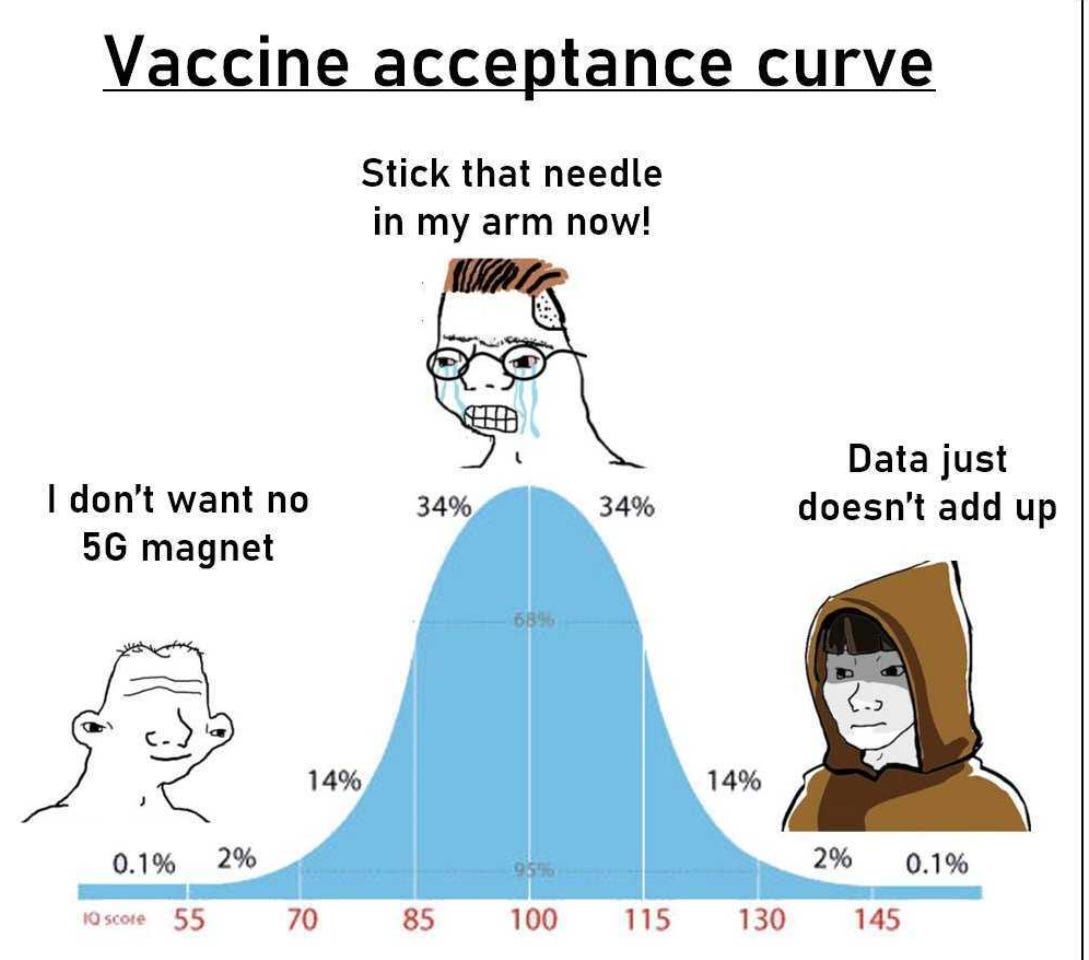
The mid-wits occupy much of our academic class. They are smart enough to read and regurgitate, but not bright enough to come up with novel theories or expand much beyond accepted parameters of thought. This cohort makes up almost our entire media and political class as well as running most academic institutions.
Many of the vaccine/Covid regime conformity theory of intelligence proponents actually take this a step further like this essay:

This essay and the one linked in the vaccine acceptance curve above are great reads and both writers were excellent on the Covid question. The peer groups of these authors seem to derive from the intellectual class while mine are the working class. As John Carter said of his peer group:
These aren’t stupid people, by any means. I’m talking PhD scientists, computer programmers, engineers. In terms of raw cognitive grunt this is a group with serious horsepower.
In the “thinking class,” I have heard and read it posited that people who did not conform to the Covid regime did so out of baseline mistrust of government, general contrariness, being too simple to understand the vaccines (which mRNA is not), or were just too dumb to make and keep an appointment (see Swedish paper below). Seriously, too dumb (with cognitive barriers) to make an appointment or read train schedules! While those who conformed suffered from a GIGO(garbage in, garbage out) data problem. For me, questioning and filtering all data or information is step one for the intelligence test known as life.
eugyppius says of the Swedish study that addressed the questions of IQ and vaccine uptake:
What the Swedish study showed, more than anything, is that in a highly compliant, consensus-driven society, cognitive barriers limit vaccine uptake.
This study looked at IQ scores from a 700,000 person cohort. The (mostly)men, currently aged between 42 and 59, were tested when they were 18. Here is the conclusion taken directly from the abstract:
There you have it. Pre-book their appointments(because they don’t understand vaccination) and the dummies will show up. This ridiculous conclusion calls into question the assumption that the pattern recognitions that take place in a testing facility and are collated onto a piece of paper or a computer screen in a single day, at a single period of time correlate to a person’s ability:
The above is a current definition from psychologists of the slippery concept known as intelligence. Now that the psychologists who define intelligence are focused on adaptation to environment and an ability to change one’s mind, do they give locked room mysteries or panic room tests to establish IQ? This is the issue I always have with the IQ and intelligence question. First define intelligence. The IQ tests seem to test some narrow aspect of some form of intelligence at best.
By my (limited) estimation, the above definition means people who work in the trades are more intelligent due to adaptability and the ability to manipulate one’s environment, which is literally the definition of many blue-collar jobs. However, this is not the belief of the thinking class. eugyppius again:
The average IQ of lawyers will be about the same as the average IQ of doctors, and both will be significantly higher than the average IQ of plumbers. This doesn’t mean doctors and lawyers matter more than plumbers, it just means that some professions are more cognitively demanding than others.
I do believe that the tests measure some aspect of what people are calling intelligence, but to me that aspect is so narrow as to be meaningless. Cognitive ability is more nuanced and includes qualities like physical coordination, artistic ability, analytical skills, social intelligence. These other aspects not captured by these IQ tests, which themselves are conjured by mid-wits from the halls of academia, where the majority of the intelligence on display is often a cut and paste/ rote memorization ability, which these tests then measure.
The thing I see that the IQ tests measure accurately is a high level of conformity and establishment thinking — e.g. the Swedish study authors still believe that the unvaccinated do not understand the stated benefits of vaccination. As if the stated purpose has given the compliant population a real understanding of virology or epidemiology. For me, the unvaccinated understood their personal risk calculus of taking an experimental gene therapy for a corona virus whose adaptation and infection rate was high but whose death rate was very low (like a common cold).
My general distaste for people lauding their IQs and considering this an indication of actual intelligence goes back to my own experience. They introduced IQ tests in the rural public school where I grew up in my 5th grade year. In 6th grade, I noted that some people I was friends with were in a special class while I sat with other friends in the normal class. It piqued my ego that they labeled these other kids “gifted”.
That year we took the IQ test again. This time the results anointed me as one of the gifted (by God?) for the following academic year. I do not remember clearly my mindset nor my environmental circumstances for the respective tests, I only know that according to the IQ test, one year I was a dipshit and the next I was gifted. For me, this invalidates much of the IQ data, other than simply measuring how a person took a particular test on a given day. It cannot test know a test subject’s motivations or personal circumstances, the environmental conditions surrounding the test, nor a multitude of other factors surrounding the test that are impossible to quantify.
That Gifted Program gave us logic puzzles and Shakespeare while the “average” students read the type of books and did the type of busy work that would have bored me to sleep. Magically all of the kids from that program ended up in the AP track (minus maybe one slacker). From an academic perspective, early placement in a program such as this had an effect on me similar to what happened with the hockey players in Malcom Gladwell’s Outliers. Essentially, all the great hockey players in Canada were born in the first few months of the calendar year, which made them the oldest and most physically developed in youth leagues. Because of this, they were given more attention and coaching and therefore developed as serious hockey players from a young age. This natural prejudice of birthday months apparently continues into professional hockey, much as early IQ tests do into advanced academia (or so my theory goes).
Ever since, when people tout IQ and high academic achievement as signs of intelligence, I am not only skeptical but actively hostile to the concept. Since that early experience, I have known high school dropouts who were brilliant autodidacts teaching themselves trigonometry so they could derive the angles to cut for a piece of art, electricians who learned the chemistry to harvest gold and platinum from circuit boards, etc. I don’t necessarily know these folks IQ scores, but they had the lowest vaccine uptake of any other group in my anecdotal dataset . I also know that I was, and am, the same dumbass who scored poorly and then well on a test that eventually proclaimed me gifted. And this gifted dumbass found all of the established interventions laughable.
The idea that anyone in the human species knows anything about the complex system that is our brain and that it can be measured in a test on one day, is as laughable as humans being able to model complex systems to predict future temperatures and weather.
I read once that there are more neural connections in a human brain than there are stars in the known universe (Carl Sagan in “The Dragons of Eden” I believe). To imagine that some social science folks could create a test that determines someone’s mental capacities and gifts is such a preposterous thesis that I have trouble taking it seriously.
From my experience as a regular, non-academic person the Covid experience reinforced my own theory of intelligence and conformity. The greatest tests of intelligence are real-world, dynamic tests that have real consequences. A person’s reaction to the Covid regime is a better indicator of intelligence than a test taken in their 19th year (perhaps they were hung over or had to take a pee). In fact, reaction to the Covid regime seems to be a nearly perfect IQ test for my own purposes. So how did you score?
Here's hoping that more people start to give academia the healthy distrust that it deserves.
Here's hoping that more people realize that "disinformation" censorship is exactly the censorship that our founding fathers attempted to prohibit.
I frequently refer to "academic incest" and "intellectual inbreeding". The greatest minds are not likely to be found in the liberal arts colleges at the university. But, mindless conformists abound. I've earned the right to say all this; I have a master's degree in educational administration.
I taught for six years in public schools, and then went into the trades as an architectural woodworking contractor. The truth is exactly as stated in this post: Skilled tradesmen live in the world of physical reality, and reality doesn't even know if you're alive, and doesn't care. Thinking positives thoughts, courage of convictions, grout think, DEI; none of them are worth a crap in the trades. If you can't outwit reality, you are screwed, and that's that. In the meantime, the liberal arts majors spend all day stroking each other and making up fairy tales that they foolishly believe.
If you care to, here's a pervious essay that I wrote, which touches on all this:
https://sezwhom.substack.com/p/were-the-smart-ones-right
Here's Maurice Samuel on the folly of IQ reliance:
"There is no test or guarantee of a man's wisdom or his reliability beyond what he says about life itself. Life is the touchstone: books must be read and understood in order that we may compare our experience in life with the sincere report of the experience of others. But such a one, who has read all the books extant on history and art, is of no consequence unless they are an indirect commentary on what he feels around him.
Hence, if I have drawn chiefly on experience and contemplation and little on books - which others will discovery without my admission - this does not affect my competency, which must be judged by standards infinitely more difficult of application. Life is not so simple that you can test a man's nearness to truth by giving him a college examination. Such examinations are mere games - they have no relation to reality. You may desire some such easy standard by which you can judge whether or not a man is reliable: Does he know much history? Much biology? Much psychology? If not, he is not worth listening to. But it is part of the frivolity of our outlook to reduce life to a set of rules, and thus save ourselves the agony of constant references to first principles. No: standardized knowledge is no guarantee of truth. Put down a simple question - a living question, like this: "Should A. have killed B.?" Ask it of ten fools: five will say "Yes", five will say "No." Ask it of ten intelligent men: five will say "Yes," five will say "No." Ask it of ten scholars: five will say "Yes," five will say "No." The fools will have no reasons for their decisions: the intelligent men will have a few reasons for and as many against; the scholars will have more reasons for and against. But where does the truth lie?
What, then, should be the criterion of a man's reliability?
There is none. You cannot evade your responsibility thus by entrusting your salvation into the hands of a priest-specialist. A simpleton may bring you salvation and a great philosopher may confound you.
And so to life, as I have seen it working in others and felt it within myself, I refer the truth of what I say. And to books I refer only in so far as they are manifestations of life.”